A Bit About Me .....

I am an amateur gardener of a small suburban garden. I don't profess to know what I am doing most of the time, I just muddle along as best I can, hoping it will turn out alright.

The main purpose of this blog is to act as a diary for myself of plants I have grown, mistakes I have made and odd bits of advice that might be of use in the future. Feel free to jump in and leave any advice or comments.

Saturday, 15 January 2011

The Problem With Plastic

Like a lot of people, I am a conscientious recycler.  I always put the paper, cardboard, food tins, plastic bottles and glass out for the recycling collection every week and take my batteries, aluminium foil, biscuit tins, rags and other recyclable items to the local Council waste site.  I'm not perfect by any stretch of the imagination though and a whole host of food packaging that can't be recycled ends up in the dustbin without too much more thought.  Let's face it, out of sight, out of mind.

A few days ago, I came across an article about the Plastiki Expedition.  The Plastiki is a boat made from 12,000 plastic bottles which is sailing the oceans raising awareness about plastic pollution, particularly in the seas.  Unfortunately, plastic does not biodegrade, once plastic is manufactured, it will always exist - somewhere.  It may crack into small pieces but it will be there, in land fill sites and in the seas.  Apparently there is an area of ocean near Hawaii that has an area polluted with plastic from all over the world that is twice the size of France!  Small pieces of plastic are suspended in the sea and are referred to as mermaid's tears.  Sadly these plastic fragments are being ingested by the marine life.  Needless to say, it is not doing them much good.  A lot of the plastic is tipped overboard from ships but lets face it, we are all guilty of plastic pollution.

So where does this fit into a gardening blog?  Well, plastic was obviously on my mind when I glanced out of my kitchen window.  It suddenly struck me how much plastic waste gardening creates, from plastic plant pots, labels and garden ties to plastic bags the compost comes in.  Whilst I am sure keen gardeners will clean and reuse their plastic pots, most households will no doubt throw them away.  Plastic plant ties are great and can be used again and again, until they snap.  Then what?  They get thrown away.

Brown or black plastic pots really aren't attractive, so it is not surprising that people transfer their newly purchased plants into ceramic pots.  Maybe if the plastic pots came in bright colours they would be more acceptable.  I have got some Thyme growing in a purple plastic pot which I don't mind too much.  We really do need to get away from plastic altogether though and don't even get me started on polystyrene seed trays.

I completely understand the use of plastic.  It is no doubt cheap and certainly convenient, as well as practical.  If plants were sold in ceramic pots there is far more scope for breakage.  Paper labels would be useless as they could tear and would certainly go soggy when wet.  With more packaging being made from corn starch perhaps there is some possibilities there.

Unfortunately, I don't have the answers.  I know one thing though, in future I will try to be far more careful about the garden products I buy and use.  Why use plastic plant ties after all when you can use a piece of string or a old pair of nylon tights cut into strips?

http://www.theplastiki.com
http://recycleplasticflowerpotsandplantseedtrays.com/

Bookmark and Share

Tuesday, 28 December 2010

Plants By Post

Back in June, my husband gave me a gift voucher for a company called Rocket Gardens.  The voucher entitled me to a compact herb garden mini plant pack.  I didn't really know what it was all about, so just followed the instructions to redeem the voucher on their website and thought no more of it.

A couple of days later, I arrived home to find a cardboard box on the doorstep which said "Plant me, grow me, eat me" on the side.  There's nothing quite like coming home to a parcel, it's a bit like your birthday or Christmas, you can't wait to open it and see what's inside.  Quickly opening the box, I was met by a whole array of baby plants, all neatly  packed for transit.

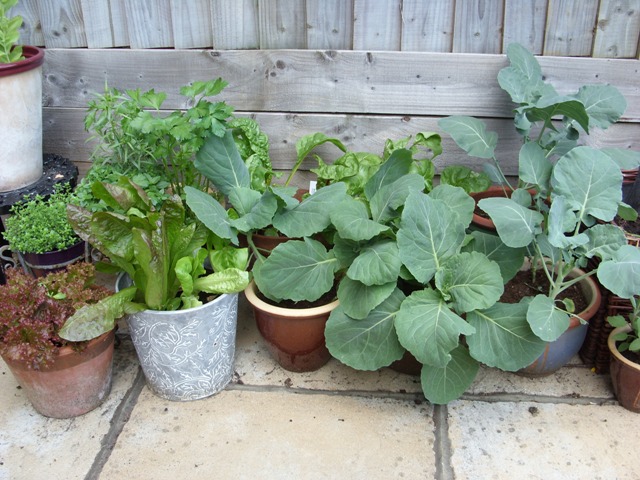
As I carefully unpacked the plants, I could not believe the variety I had been sent.  I had expected some herbs and herbs I got, rosemary, chives, thyme, parsley, mint, sage, basil and marjoram to be precise.  Not only that, I got various types of lettuce, calabrese, cabbages and rainbow chard.  It was an absolute feast!  Well it would be when they had all grown.

I have to admit it did take a while to plant them all.  As there was far more than I was expecting, I had quite a job scouring the garden shed for pots.  The lettuces ended up sharing but I don't think they were bothered.  As well as the plants, which were all clearly labelled, there was also clear instructions for planting and care of the various plants.  You couldn't really go wrong.

I did wonder how well the plants would do, particularly with my tendency to forget to water for days on end in the summer.  The plants were really healthy though and all thrived, in spite of me.  The only problems I encountered were with the caterpillars which I have already mentioned in a previous blog entry.  Even now in the depths of winter, with a foot of snow recently, the herbs, cabbages and rainbow chard are all still flourishing in there pots on the patio.  The cabbages have made an amazing comeback having been stripped bare by the caterpillars.  Even the calabrese managed a small head despite having hardly any leaves.  I haven't had the heart to eat it!

Looking on Rocket Garden's website, www.rocketgardens.co.uk, you will see that they offer a whole range of plant packs suitable for the window box gardener to allotment gardeners.  All of the packs clearly show the number and variety of plants in the pack, as well as the space required for planting.

The pricing seems to me to be very reasonable for the number of plants and the quality.  Obviously it would be cheaper to by packets of seeds and grow your own from scratch but if you don't have the time or a greenhouse, Rocket Gardens offer the perfect solution.  I will certainly be using them again next year, so roll on the spring!

Bookmark and Share

Friday, 17 December 2010

Christmas Wreaths

During the festive season, like lots of other people, I like to hang a wreath on my front door.  For years , I have been buying a holly wreath and spending £6-£10 each time.  A couple of years ago, having just bought one, it suddenly struck me that I could probably make my own pretty easily and save myself some money.  In the New Year, I simply took the wreath I had bought apart and kept the wire ring base for future use.

Last year, I took the plunge and couldn't believe how easy it actually was to make.  This year, I have done the same again.  Besides the wire ring, which you can easily buy from a garden centre, recycle from an old wreath or make yourself, the main material is foliage.  If you have a garden, you can simply raid the shrubbery, if not, there is plenty of free holly and ivy in the countryside.  You don't even need very much.

I used the shrubbery in my garden and decided to use mainly honeysuckle and mulberry. The honeysuckle is really useful as it is in long, flexible tendrils.  I'm sure someone somewhere will tell me that they are not traditional or have the wrong connotation in Victorian flower language but it's my wreath and I will use whatever comes to hand.  That's the joy of making your own, you can use whatever you like!

When I had stripped the wreath in January this year, I left all of the wires in place, together with the bow and pine cones which were on the wreath when I originally bought it.  Leaving them on not only saved time but also offered anchor points for me to thread the honeysuckle into.  I only roughly secured each piece as I planned to tie it all in more securely at the end.

Having covered most of the base in honeysuckle, I then added the mulberry.  I quite like the speckled leaves as well as the different leaf size and shape, I think it adds more interest.  It is worth remembering that if you do decided to use holly, wear gloves so you don't get prickled.  That's another good reason to raid the shrubbery!

Once I was happy with the foliage, I wound a long piece of gold tinsel around the wreath.  Not only does it give a bit of sparkle, it is also really useful for tying in the foliage securely to the wreath and also hides a multitude of sins if you have stalks and gaps showing.  Finally, I jiggled the bow and pine cones into more prominent positions and it was ready to hang on the door.

Bookmark and Share

Thursday, 2 December 2010

Winter Wonderland - Again!


I can't believe the garden is completely covered in snow - again!  It only seems a couple of months ago since the last lot.  To be fair it was 10 months ago but still, so soon?
 
I have to admit the garden does look lovely when the snow is undisturbed and a thick carpet.  Not very practical though.  The cats peer out the door and don't want to go out.  They seem to develop bladders of steel.  We end up digging paths for them from the door to the bushes which they then happily trot up and down.

As for the poor birds, who knows what they make of it all.  It really makes you realise how important it is to leave food for them.  My garden was a veritable bird buffet this morning.  Pigeons were lined up on the fence, a whole flock of blue tits were feasting on the peanuts and seed.  They were swiftly joined by a robin, dunnock and even a magpie pecking at the fat filled coconut shell hanging from the shed roof. 

Sunday, 7 November 2010

Desert Forests

I have just got back from another trip to Las Vegas and am immediately struck again by how green England is in comparison.   Hardly surprising as Las Vegas, despite meaning "the meadows", is very arid due to its location in the Mojave Desert.  The trees tend to be palm trees and much of the green grass is heavily watered every night to keep it green or is astroturf!

On our first trip we went on a trip to the Grand Canyon which is absolutely spectacular.  On the way we passed through a Joshua Tree forest.  Say the word forest and you immediately imagine tall, lush trees, densely packed and maybe a hint of pine.  As the Joshua Trees manage to sustain life in the most inhospitable of terrains with very little water, they have adapted to survive and even thrive.  The resulting forest is slightly eerie but also has an intriguing quality all of its own.  In some respects you feel it wouldn't look out of place on another planet.

Mostly found in the Mohave Desert, the Joshua Tree is a member of the Yukka plant family and got its name from the Mormons who travelled across the Mohave Desert during the mid 1800's.  The plants survive the harsh conditions by growing extremely slowly once established.  The largest trees can be hundreds of years old but still relatively small in tree terms.  Whilst areas of the desert are densely populated with trees, the size of the trees actually makes the forest seem quite sparse.

Whilst I can't see me ever growing a Joshua Tree in my English garden, I do find them very intriguing.  I have to admit, I do quite like the name, which was even used as the title of a U2 album.

Bookmark and Share

Sunday, 22 August 2010

Sculpture In The Garden

I am a real lover of sculpture, with no particular preference for media or form.  Whilst I am happy to wander around a gallery, I am more happy viewing sculpture outside in a natual landscape.  Somehow, if placed correctly, sculpture just works really well with nature.  The surrounding planting, or lack of, has huge bearing though it has to be said.

Yesterday, I visited the Beaulieu Estate in Hampshire, which is home to the National Motor Museum, as well as having the house, abbey and gardens open to the public.  The organic kitchen and Victorian flower garden are well worth a walk around, even in the rain! 

Unbeknown to me, the Surrey Sculpture Society were holding an exhibition in the gardens from 25 June to 22 August 2010, with 85 sculptures in a variety of media, from steel and bronze resin to clay.  I'm sure I didn't see all of the sculptures but some of them were really fabulous.


Bookmark and Share

Tuesday, 17 August 2010

Natural Pest Control

By complete chance, I have found a solution to my caterpillar problem.  I was quite happy to sacrifice the calabrese to the caterpillars as I couldn't kill the furry monsters.  However, I have found a plant they like even more - watercress!

I bought a growing pot of watercress at the supermarket and decided to put it out on the patio next to the pots of cabbage and calabrese.  The caterpillars migrated to the watercress on their own.  One morning when I went outside, I looked over at the watercress and spotted it had been completely stripped of leaves, on closer inspection, I found it heaving with caterpillars.

It actually makes perfect sense, watercress is in the same family at cabbage.  As watercress has a strong, peppery taste, I guess it must have certain chemicals which caterpillars are attracted to in greater quantities than the cabbage and calabrese.  The caterpillars are certainly happy anyway.

I have now relocated the watercress plant to the end of the garden, together with the caterpillars.  The few stragglers still on the calabrese have been rounded up and moved to the watercress with the rest.  I have even bought another plant for the caterpillars to eat, as I can't let them go hungry!

Bookmark and Share